rice farming
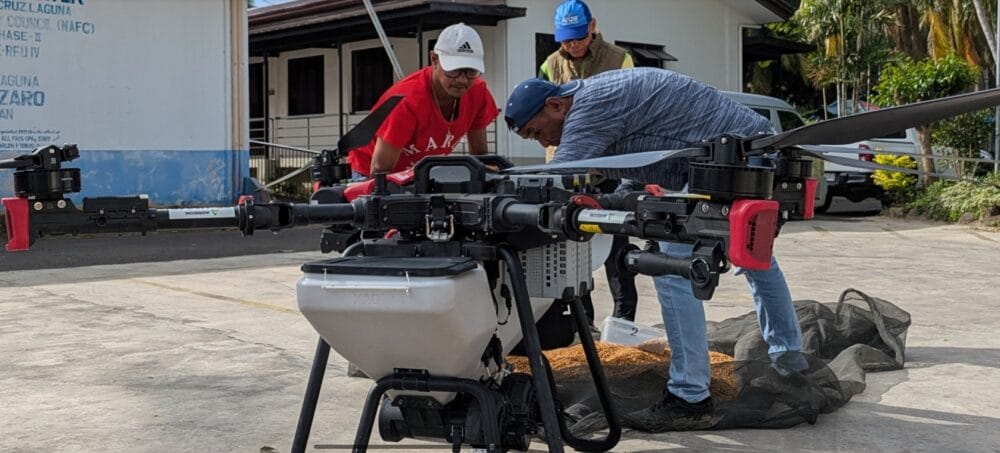
Los Baños, Philippines: The International Rice Research Institute (IRRI) recently showcased drone-assisted rice farming technologies to farmers in Laguna province, demonstrating how modern tools can transform traditional rice cultivation and improve productivity.
The technology demonstration, held in collaboration with the Field Agricultural Extension Services–Office of the Provincial Agriculturist (FAES-OPA), introduced farmers to drone-based direct seeding and crop management techniques under the Drones4Rice project. The initiative aims to accelerate the adoption of precision agriculture among smallholder rice growers in the Philippines.
During the event, farmers witnessed how agricultural drones can efficiently distribute seeds, fertilizers, and crop protection inputs across rice fields. The drones are capable of carrying up to about 50 kilograms of materials and can cover roughly one hectare of farmland in 10–12 minutes, significantly reducing the time and labor required for planting and crop care.
IRRI experts explained that drone-assisted farming helps improve precision in seed and fertilizer placement while minimizing human labor. The technology is equipped with advanced features such as radar sensors for obstacle detection and Real-Time Kinematics (RTK) systems that allow planting accuracy within one to two centimeters.



Also Read: Top 10 Benefits of Organic NPK Fertilizers for healthy plants
Officials said the demonstration was designed to familiarize farmers with digital farming tools that can boost efficiency and sustainability in rice production. By reducing dependence on manual labor and enabling faster field operations, drone technology could help farmers lower costs and increase yields.
The initiative is part of broader efforts by IRRI and local agricultural authorities to modernize rice farming and encourage the use of smart technologies. Experts believe that wider adoption of drone-assisted farming could strengthen food security and help farmers adapt to rising production challenges in the region.
Also Read: Agriculture news